Agribot v2 · ground rover
A rocker-bogie and corner-steering rover concept for crop rows, with a compact arm concept for plant-level interaction. The first simulation work centers on spawning the rover and making ROS 2 driving repeatable.
Current work · AgriTeam Lab
A simulation-first agricultural robotics program. My focus is embodied robotics software: start with repeatable ROS 2 rover behavior in a simple crop-row world, then develop toward a coordinated robot team.
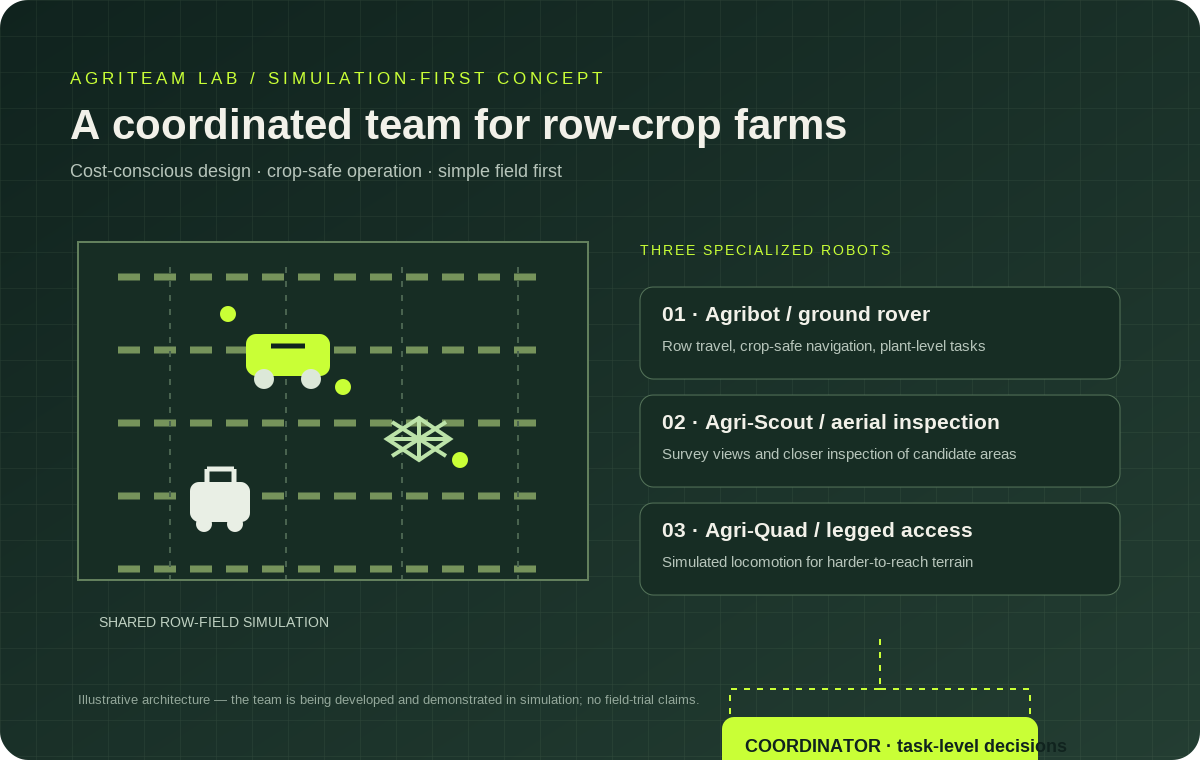
01 / THE ENGINEERING PROBLEM
Smallholder row-crop farming calls for machines that can work within crop rows, handle plant-level tasks, and stay practical to build. AgriTeam explores those constraints through robot design and autonomy, with cost and crop-safe movement treated as design requirements rather than proven outcomes.
The engineering starts with a simple row-field simulation. This keeps the immediate work focused on robot behavior and repeatable ROS 2 demos instead of detailed terrain or GIS work.
02 / SYSTEM ARCHITECTURE
A rocker-bogie and corner-steering rover concept for crop rows, with a compact arm concept for plant-level interaction. The first simulation work centers on spawning the rover and making ROS 2 driving repeatable.
A simulated UAV role for overhead surveys and image capture. Terraced environments are a later simulation variant, after the simple row field.
A simulated quadruped role for rougher terrain scenarios. It remains part of the simulation concept, not a field-tested farm robot.
Assigns work to the appropriate robot while each platform keeps responsibility for its own motion and motor control.
These are the project’s design roles. The aerial and legged platforms remain simulation concepts; no integrated physical fleet or field performance is claimed.
03 / DEVELOPMENT SEQUENCE
Use a simple row-field world to spawn the rover and build a repeatable ROS 2 driving demonstration.
Build on the rover foundation with robot design and integration, sensing, navigation, and autonomy in simulation.
Extend the simulation concept to the aerial and legged platforms, joined by task-level coordination.
04 / MY ENGINEERING FOCUS
My role is centered on ROS 2, embedded systems, robot design and integration, navigation, and autonomy. In the first stage that means bringing up the rover in the row-field simulation and making its motion repeatable. Terrain mapping and GIS are collaboration work, while my contribution stays focused on the robot and its behavior.
05 / SCOPE & EVIDENCE
The current AgriTeam program is simulation-only. Cost is a design constraint, not a measured price or savings claim; crop-safe movement is a design goal, not a field-validated result. The project is being documented around its architecture, decisions, and repeatable demonstrations. Public notes and selected project details can be shared without publishing the full source repository.