Object intelligence
Real-time detection and tracking with operator-directed tap-to-track workflows.
Selected work
An AI-enabled surveillance and security UAV ecosystem delivered to Nepal Police—built around live intelligence, reliable field operation, and one coherent ground-control experience.
01 / THE PRODUCT
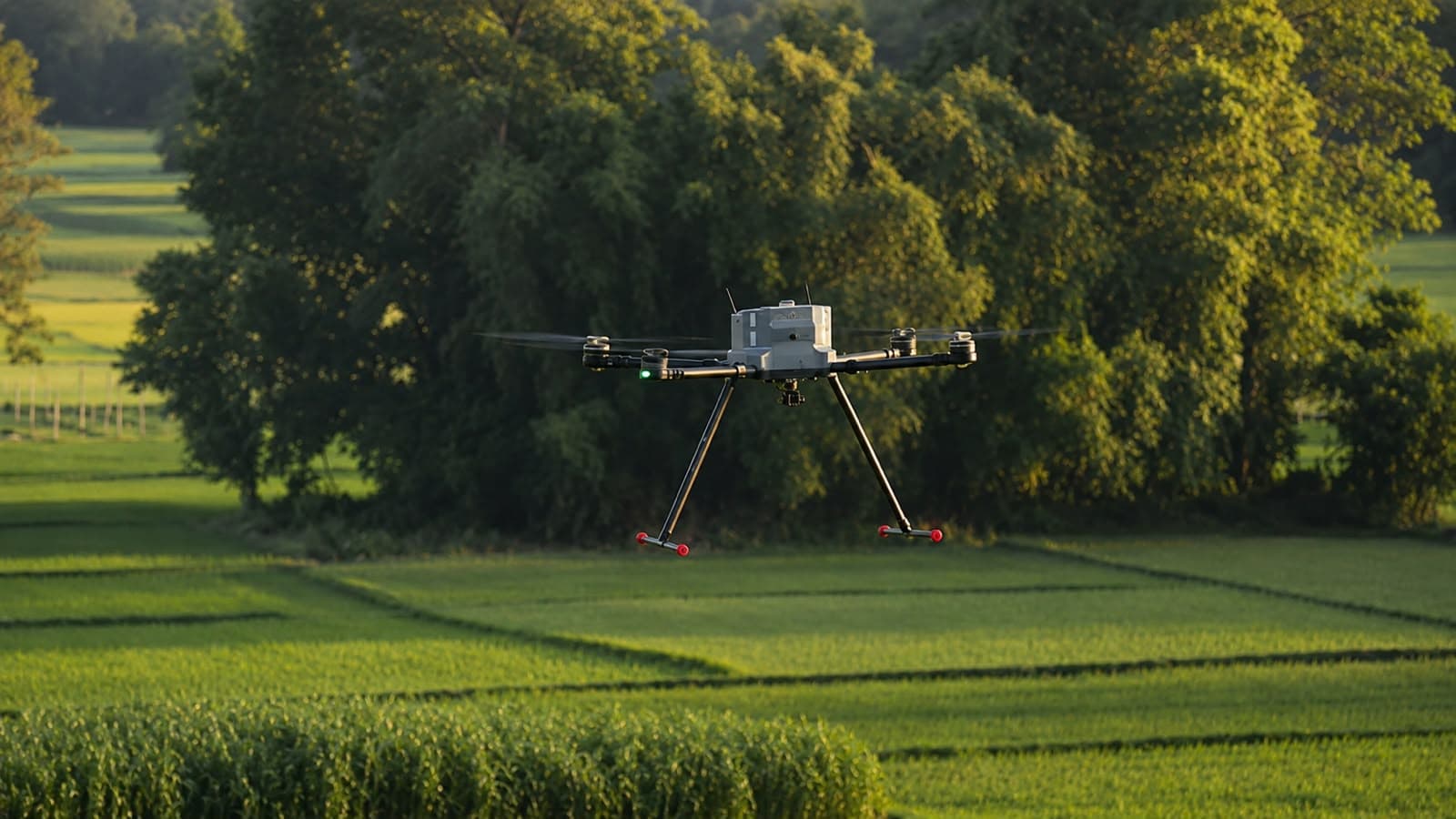
SkyReaper combines the aircraft, stabilized imaging, flight control, radio and video links, edge compute, and an Android ground-control station. The surveillance configuration adds onboard AI for persistent intelligence. The payload configuration prioritizes lift, obstacle awareness, and mission-specific operator tools.
The result is more than a drone: it is a distributed system that has to remain understandable and dependable while several hardware and software layers operate at once.
02 / CAPABILITIES
Real-time detection and tracking with operator-directed tap-to-track workflows.
People counting and spatial heatmaps for large gatherings and public-safety monitoring.
Plate detection, OCR, visual overlays, and an offline evidence log on the ground station.
Operator-drawn zones with persisted geometry and class-specific occupancy counts.
Zoom, thermal and live video feeds support wide-area search and mission awareness.
A second configuration supports heavier payload delivery and obstacle-aware flight.
03 / MY CONTRIBUTION
I led development of SiyiGCS 2, the Android ground station used on the SIYI MK32 tablet. The application brings flight, vision, analytics, and settings into one interface, with dual video feeds, tracking controls, ANPR overlays, crowd heatmaps, traffic zones, and mission-specific reticles.
I also owned the integration path across the camera and tracking SDKs, RTMP relay, Pixhawk telemetry, and the Raspberry Pi AI service. That meant turning vendor protocols and several independent devices into a system an operator could use as one product.
04 / ENGINEERING STORIES
The tracking module could combine several logical messages in a single TCP read. I replaced the naive read pattern with an accumulator that extracts complete packets by declared length, preventing silent data loss.
Dual-feed switching failed whenever Android destroyed an underlying video surface. Persistent surfaces and visibility switching preserved both streams and made switching reliable on the fixed Android 9 hardware.
Because the tablet's USB-C connection is occupied in the field, I designed crash and relay logs to be stored and shared directly from the app—no debugger or cloud service required.
When packaged FFmpeg wrappers failed on the target tablet, I moved the relay to a bundled static binary managed as a foreground service, giving the team a more predictable HEVC streaming path.
05 / EDGE AI
The surveillance configuration uses a Raspberry Pi 5 with a Hailo-8L accelerator. Its shared vision service keeps frame capture, neural inference, and slower OCR work asynchronous, so one expensive task does not freeze the live pipeline.
The Android application translates those outputs into useful operator context: bounding boxes, plate records, heatmaps, and zone counts. Processing and evidence capture remain available without a cloud dependency.
06 / CONTEXT